
The AI safety netfor bodily-injury claims.
Lyncea gives every BI adjuster an independent second read of the demand and full medical packet, flagging missed facts before settlement.
Co-designed with senior BI adjusters at top-10 US auto carriers. Why we exist
From the field
When claims leaders at auto carriers come to us, they often say:
We get medical records sometimes from attorneys that are 10,000 pages. And an adjuster is going to have to go through every single page.
You're always going to miss something. Usually not the big things, but the small things, and that one detail can have a real impact on the file.
The material stuff has to be exactly right: the bills, how long they treated, the life impact.
We ask vendors, what's your accuracy? We look into it and say: you're missing a whole lot.
Three forces are widening bodily-injury claims leakage.
Demands at near-zero cost.
The cost to file a PI claim fell from $2,000+ to under $100. Demands got longer, more frequent, and machine-drafted, each packet engineered for leverage.
Nuclear verdicts keep climbing.
Awards keep climbing, and every missed detail now carries bad-faith risk on top of the indemnity dollars.
Plaintiff firms, rolled up.
Plaintiff firms are being rolled up and funded at scale. Pair that capital with AI and the volume and aggression of BI claims compounds.
Plaintiffs industrialized. The counterweight on the carrier side is accuracy on every file.
What Lyncea is
A second read on every BI file, before it settles.
Lyncea is the AI safety net for bodily-injury claims. Adjusters work the file exactly as they do today. Lyncea reads the demand, the full medical packet, and the adjuster's evaluation in parallel, and the cross-check takes 5 to 15 minutes at the end. Nobody waits on the tool.
- Step 1Demand letter received
- Step 2Read records and build evaluation
- Step 3Set valuation range
- Step 4Cross-check with Lyncea
- Step 5Send to attorney
Missed facts surface while the money is still on the table, in both directions.
Treatment gaps, prior injuries, billing inconsistencies, and unsupported procedures, flagged before settlement.
Genuine severity in a litigious venue, flagged before it becomes a bad-faith problem.
Hundreds of checks built from senior adjuster interviews, grounded in jury-verdict data, ISO prior-claim history, telematics, and the first independent crash-site photos licensed for claims defense. Every finding cites the source page, one click away. The adjuster accepts, dismisses, or probes each flag, and every action is logged.
Hundreds of proprietary crosschecks.
Adjuster interviews taught us which checks matter in which case type. Every claim we review sharpens the bank.
Venue and severity context.
Every flag is grounded in what similar injuries resolved for, by venue and injury type. Findings hold up in negotiation.
- Jury-verdict data
- ISO prior-claim history
- Telematics
- Independent crash-site photos
See it work
Watch it catch the fact on page 735.
One real-shaped claim. The adjuster's evaluation on the right; what Lyncea surfaces, cited to the page, as it reviews in parallel. Hover to pause, or click any finding to jump to its source.
This is one claim. You run thousands.
This is one claim. You run thousands.
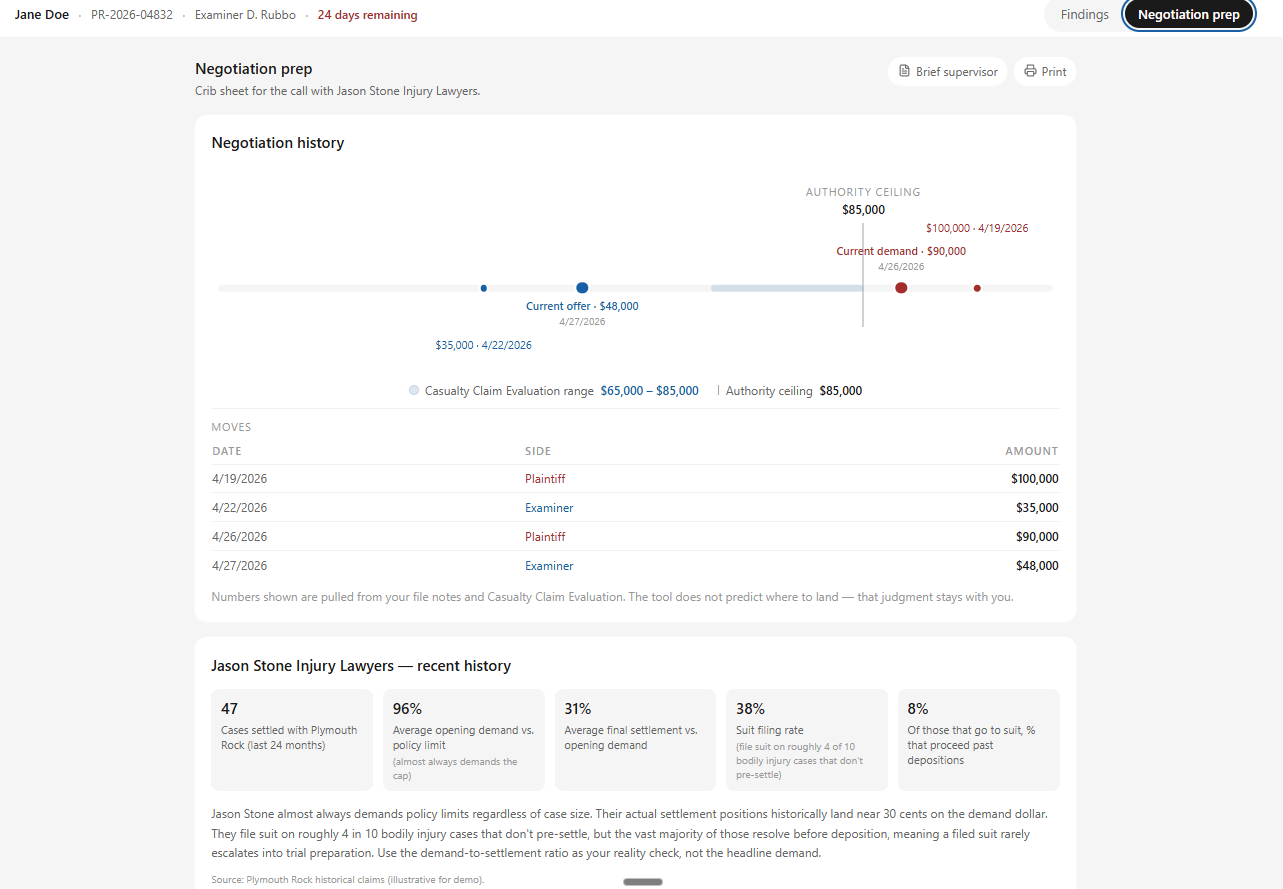
Accepted findings become the response letter. Every counter cited to its source page. Before the call, the adjuster also sees the opposing firm's settlement history and where this claim sits against the range.
Defensibility
Built to survive the deposition.
Every flag is evidence, not opinion.
Each finding cites the exact source page, verifiable in one click. Nothing in the file rests on an unsourced AI claim.
The adjuster stays the decider.
Lyncea never sets or predicts a settlement number. Your evaluation, your authority. Aligned with emerging NAIC expectations for AI in claims.
An audit trail by default.
Every flag, acceptance, and dismissal is logged. If a file is challenged, you can show exactly what was reviewed and why.
Proof
Co-built with the people who do the work.
We knew details were slipping past our casualty evaluations … Lyncea runs a second read on every file in parallel. The cross-check takes minutes and every flag links to the page it came from. This is exactly how I would design the process if I was building software.
Designed alongside senior BI adjusters, supervisors, and claims leadership at top-10 US auto carriers. Every feature traces back to a real file: a flag a seasoned adjuster would have caught, a fact buried on page 735 that changes the valuation.
The math
What recovering leakage is worth.
Industry audits put BI claims leakage at a meaningful share of every book, and AI-drafted demands are widening it. We believe 1 to 5% of the BI book is recoverable when missed facts are caught before negotiation instead of after.
Caught before negotiation instead of after, when the money is already gone.
Lyncea prices at a fraction of recovered leakage.
- The safety net on every BI file
- Negotiation prep add-on
- US data residency
Pilot proposal
One month to set up. Two months to prove it.
Setup
Connect to closed BI claims. Calibrate to your evaluation format, fee schedules, and authority thresholds. Train two to three lead adjusters.
Run
Lyncea reviews live or recently closed claims in parallel with adjusters. Weekly readouts on flags surfaced, accepted, and dismissed.
Benchmark
Compare findings against your team's own outcomes. Quantify saved indemnity, time per file, and flag accuracy. Decide rollout scope.
FAQ
Common questions from claims executives.
Ready to give your adjusters a working safety net?
Pilots start with one month of setup and two months running on closed claims. We benchmark against your team's own outcomes.